

It’s always exciting when new teams come together. Having an imperative to partner, a common goal, and deciding to embark on a partnership are great first steps. Even when you have these, though, it’s sometimes hard to know how to get a partnership really started, and what the partnership might look like throughout its lifecycle.
At TPI, we’ve identified stages of a partnership lifecycle. From the diagram, you’ll see it doesn’t just happen in a straightforward, step-by-step process – some steps need to happen together, or to keep happening across the life of the partnership.
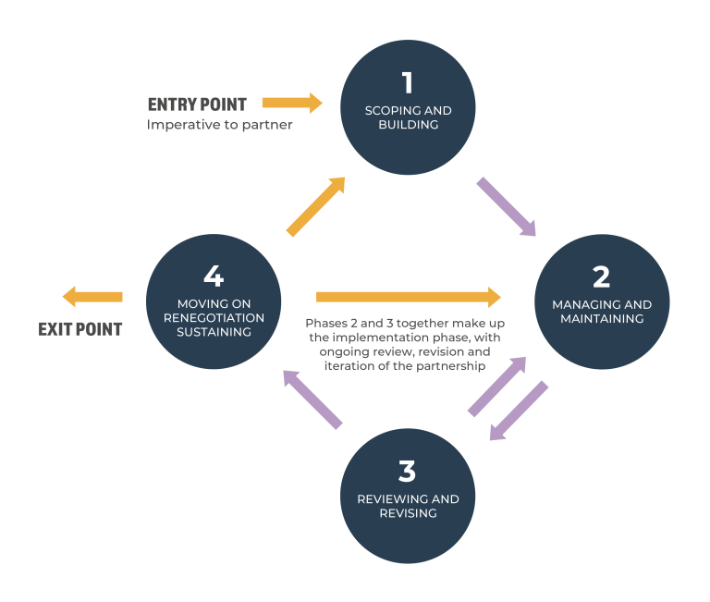
Stage 1: scoping and building
In stage 1 you’ll be mapping the landscape of relevant stakeholders and initiatives; engaging key stakeholders to together build a full understanding of the issue; identifying which stakeholders are likely to become partners, guided by your organisation’s partnering strategy; and then undertaking the process of engagement and negotiation to collectively develop a value-creating partnership.
Stage 2: managing and maintaining
Stages 2 and 3 are the implementation phases of the partnership. At the beginning of stage 2, partners establish the governance, operational and management structures, allocate human resources and financial resources (or mobilise resources from an external source), and start to plan together.
Stage 3: reviewing and revising
A well-maintained partnership includes a culture and constant process of review and iteration – monitoring progress towards goals, reviewing the health of the partnership, and making the changes necessary to keep a partnership on track, including continuing to strengthen the building blocks of effective partnering.
Depending on the duration of the partnership, you might iterate stages 2 and 3 multiple times.
Stage 4: moving on
Eventually, for any number of reasons, the partnership will move on. Perhaps it has reached a conclusion because the objectives have been fulfilled, or maybe an essential resource, like a key partner or major funding stream, is no longer available. Some partnerships wrap up because the work is handed over, perhaps to a new entity designed to scale up the activities, or maybe its proof-of-concept or pilot work will be mainstreamed by existing stakeholders.
There is a plethora of choices as to what the ‘moving on’ stage will look like, and the right choice depends on the partnership. Ideally, partners have been thinking about this stage from the start, and there are common understandings about what the partnership will achieve, when it will have finished its life, and what that ‘moving on’ means.
For more information, check out our Partnership Lifecycle page on the TPI and UNDESA Partnership Accelerator.

