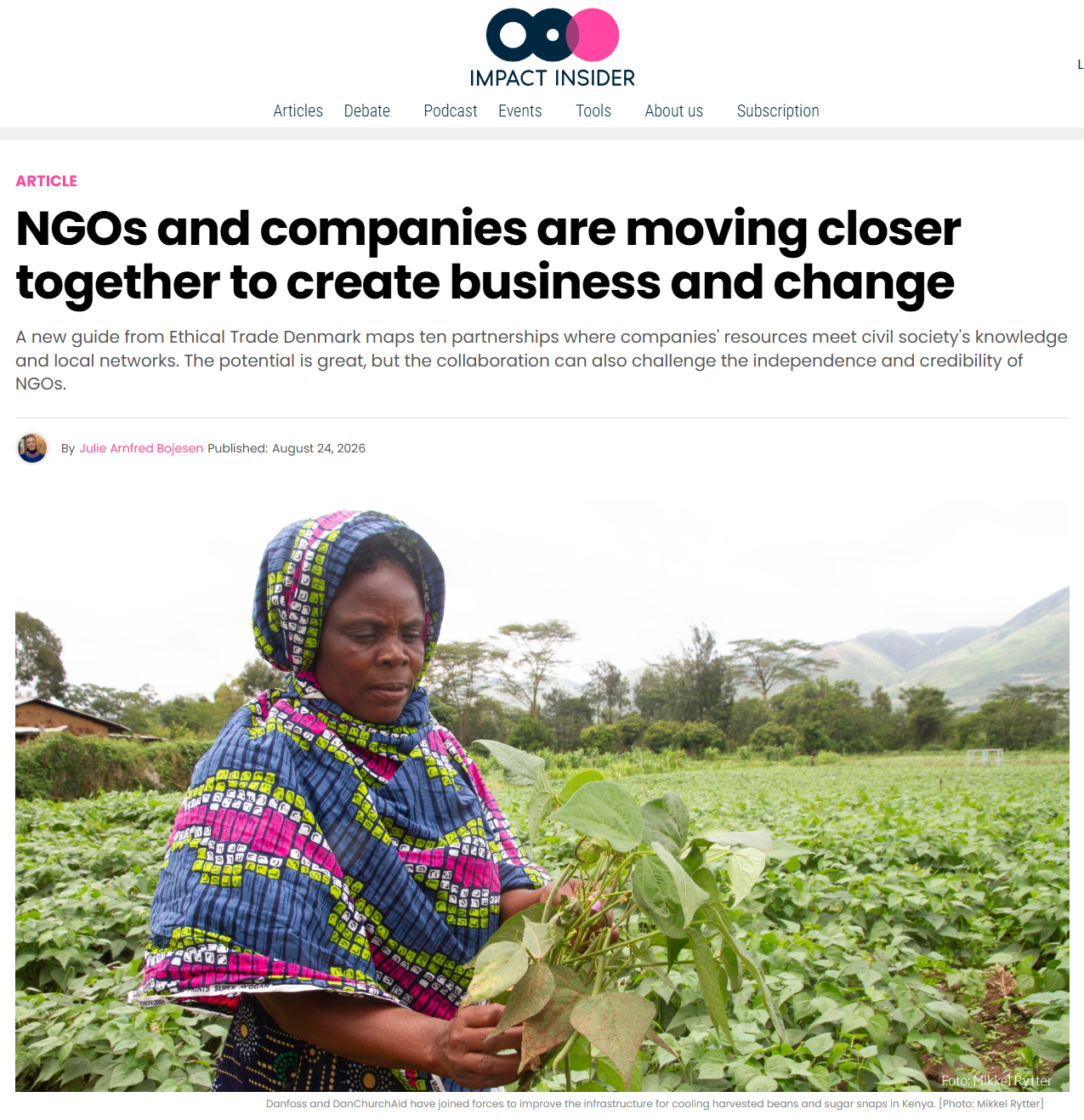
Ethical Trade Denmark has produced a new guide, mapping ten case studies of global value chain partnerships that bring together corporate resources with civil society’s knowledge and local networks. In examining what it means for these very different sectors to work together and to use their respective strengths to solve shared challenges, Impact Insider spoke with TPI’s Executive Director, Darian Stibbe.
Impact Insiders’ article – NGOs and businesses move closer together to create business and change – is available in full (in Danish) on the Impact Insider website here.
Different types of partnerships and collaborations between companies and civil society have existed for decades. Nonetheless, in its recently published guide to value chain partnerships, Ethical Trade Denmark highlights two key developments behind a renewed focus on working together and the emergence of multi-sector strategic partnerships.
The first is that global value chains are increasingly shaped by supply chain disruptions caused by geopolitical instability and climate change – and businesses recognising their interconnectedness. Director of Ethical Trade Denmark Nanna Callisen Bang notes that geopolitical turmoil creates vulnerable supply chains for many businesses, and that strengthening collaboration with suppliers and local partners is a much-needed response.
The second development Nanna Callisen Bang highlights is the pressure on companies to act on responsible sourcing because of greater access to information that is making supply chains more transparent.
For Poul Fritz Kjær, Professor of Governance and Sociology of Law at the Copenhagen Business School and specialising in global value chains, these pressures are leading businesses to improve their resilience and security, and to engage in more cross-sector partnerships.
Among the case studies in Ethical Trade Denmark’s new publication, Senior Advisor Sanne Borges describes the benefits of Amnesty International Denmark’s recent partnership with sportswear brand Hummel. In particular, for businesses to understand and improve working conditions, Sanne Borges highlights that local knowledge and engagement with local representatives, NGOs and employees are essential.
However, partnering can be difficult, especially across multiple sectors. Alongside the many benefits identified, these partnerships can bring risks too, both for businesses and for NGOs. Prof. Poul Fritz Kjær points out that there’s often an unequal balance of power in the business’s favour, and there’s a risk that NGOs face push-back from members and supporters by engaging with certain businesses.
Impact Insider asked TPI’s Executive Director, Darian Stibbe, how to manage these risks and establish effective partnerships.
Darian has seven tips for minimising risk and maximising a partnership:
- Find a genuine alignment of interests. Both businesses and NGOs must understand that social and environmental value can be reconciled with good financial results. When interests and business value are aligned, it can lead to both scaling and change.
- Transparency, communication and honesty form the foundation. The risky partners may well be the right ones. They must be handled carefully, and trust is crucial. It requires full transparency between partners, but also between organisation and members, and between company and customers.
- Prioritise building the relationship. Trust takes time to build. It is also about individuals who need to get to know each other. Start by working together, so you do something that builds trust.
- Things take time. Enter the collaboration with your eyes open. It is incredibly hard, and you will almost certainly end up saying “Why did we agree to this?” It takes time — and probably more than you had imagined.
- Prioritise strengthening capacity. Most organisations are not built for collaboration, so it also requires training. Invest in strengthening existing staff, and hire new people specialising in partnerships.
- It starts at the top. The director sets the direction, and if the management decides that partnerships are to be prioritised, it will leave its mark throughout the organisation. A culture of collaboration will grow if leadership rewards partnership solutions, adapts internal structures and invests time and resources.
- Allow room to fail. If you don’t fail, you’re not doing sufficiently exciting things. Here too, leadership must be open and encourage employees to take chances and learn instead of coming down on mistakes.
Ethical Trade Denmark’s guide suggests partnerships are the way forward. They require will and support, including from organisational management. Nanna Callisen Bang concludes that, although most NGOs partner primarily with the public sector, there is much inspiration to be found in cross-sector and international collaborations with businesses.
TPI is grateful to Impact Insider’s Editor-in-Chief, Carsten Terp, and the Impact Insider team for the invitation to take part in this conversation.
References and quotations included in this summary have been translated from the original article in Danish.

