RPLC and partnership
How the Regenerative Production Landscape Collaboratives benefit from partnership
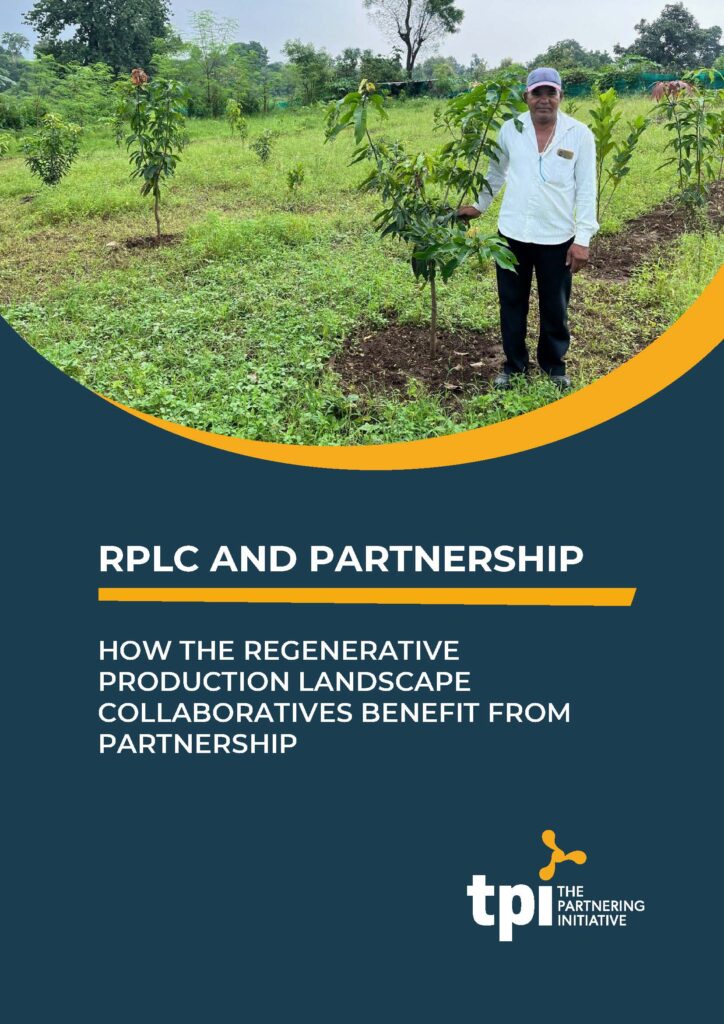
Developed with Laudes Foundation, this research shows how the Regenerative Production Landscape Collaboratives use multi-stakeholder partnership to transform farming across four countries: better livelihoods for farmers and regenerating ecosystems, through government, business and civil society working together.
Most programmes tackle a single social or environmental problem, or a single value chain. A landscape approach works differently: it addresses many interconnected issues across a geographic area, and the people who depend on it for food, livelihoods, income and identity. This paper looks at how one such approach, the Regenerative Production Landscape Collaboratives (RPLC), depends on and benefits from multi-stakeholder partnership.
It focuses on RPLC India, founded in 2021 by Laudes Foundation, IDH and WWF India, which brings together government, business, NGOs and philanthropy to transform farming in two regions of Madhya Pradesh, so that farmers grow crops using regenerative methods, smallholders and communities thrive, and businesses can source responsibly. It also compares RPLC programmes in India, Pakistan, Tanzania and Brazil, which share a landscape approach but differ in which sector drives change.
What it covers
- What motivates each partner: farmers, the state government, civil society organisations and companies.
- The benefits of partnership so far: a governance system that has built trust and credibility between sectors, shared expertise, and farmers’ growing confidence in regenerative methods.
- What transformation will take: collaboration over five to ten years with patient funding, confidence for businesses that they will gain commercial value and verified impact data, and public-private collaboration that is institutionalised so it lasts.
What it means for you
The paper is most useful for funders, companies and governments involved in landscape approaches, and for anyone thinking about how partnerships can last.
- Funders should plan for patient funding over five to ten years, because the report finds that transformation in a landscape takes that long.
- Companies need confidence that they will gain commercial value and verified impact data, and the report shows that this confidence is what keeps them committed.
- Governments should institutionalise public-private collaboration, so that it outlasts individual leaders and projects.
- Anyone starting a landscape approach should map what motivates each partner, from farmers to the state government to companies, because those motivations differ widely and shape how the partnership works.
By Tom Harrison, The Partnering Initiative, December 2024. Published by TPI and RPLC, with funding from Laudes Foundation.
- TypeCase study
- Published2025
- ProgrammeTransform