

This resource aims to provide newcomers to the world of partnerships, or partnership practitioners wishing to explore TPI’s perspectives on partnering, with an overview of some of the key concepts, frameworks, and thinking that TPI has developed over 20 years. These were developed not only to make sense of the world of partnerships, but to actively support and shape and lead it in the most effective, innovative and value-maximising ways to achieve our shared global development agenda.
This introduction is split into three sections, as seen below, starting with the why and what – the imperative for effective, innovative and transformative collaboration across sectors to deliver the 2030 agenda, exploring why to partner and when to partner, definitions and typologies, stakeholders and value creation.
The second section focuses on the process of partnering itself, outlining essential elements such as the key building blocks, the journey from concept to agreement, and the phases of the partnership lifecycle. The final section explores what holds it all together and makes partnerships thrive or fail: the partnering relationship, and the core elements from trust to power to mutual benefit and accountability.
Feel free to dip into specific sections by clicking on the links below, or to work through the full introduction in sequence, start with ‘Why and when to partner‘ and follow the links to next topics at the bottom of each page.
I. Partnerships: why and what?

Why do we partner and when? What are partnerships, how do we define and categorise them? What does each sector bring to the table and how do they create value?

Why and when to partner
Partnerships are essential to deliver the 2030 Development Agenda.We partner across societal sectors because by aligning and combining resources we are able to deliver more – more efficiently, more sustainably, more holistically, more transformationally. Each sector has powerful and unique resources they bring to the table.
Partnerships can happen when there is sufficient alignment of interest, a compelling vision for all partners, and when sufficient net value can be created through partnering. But is partnership always the best answer for every development challenge? Find out more about when to partner, and when to opt for a more traditional approach.

Defining and categorising partnerships
There are multiple different forms and types of partnership. To make sense of this, TPI uses a framework that looks at three different key forms of collaboration, from leveraging resources via doing ‘traditional’ development better, all the way through to ‘Transformational’ development.

What each sector brings to the table
What are the unique resources that different actors bring to the table? In this section, we look at the different resources brought by different sectors of society, that can be brought together, like jigsaw puzzle pieces, to create innovative, powerful partnerships that will help implement the 2030 Agenda.

Given the time and challenges involved in partnering, the primary driver for working through MSPs must be that, by combining our resources, we can deliver far more than we could alone: i.e. the partnership must be able to deliver more than the sum of its constituent parts. Additionally, every partnership must create net value for each partner.
II. The partnering process
What are the key components of an effective partnership? How do partners, and the partnership itself, successfully move from initial concept to agreement? What is the typical lifecycle of a partnership?

For partnerships to deliver as effectively as possible, there are a set of four key Building Blocks that need to be developed and continuously maintained. The Building Blocks are distilled from the success factors for partnership highlighted by multiple organizations over many years.

TPI has developed a model to illustrate the collective journey of the partnership through engagement and formation to the point of partnering agreement. It highlights the central joint pathway that partners jointly take in developing the partnership, as well as the organisational journeys each partner must take individually to be confident and ready to partner.
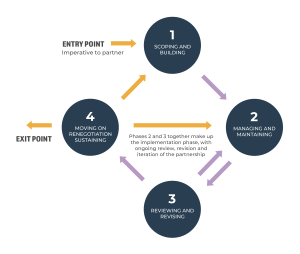
TPI’s partnership lifecycle framework illustrates the ‘typical’ life of a partnership from entry point to exit point through four key stages: scoping and building, managing and maintaining, reviewing and revisiting, and finally moving on, renegotiating, or sustaining.
III. The partnering relationship
Partnerships are driven by a complex and everchanging relationship among the partners. Strong, trust-based relationships can overcome the inevitable challenges of partnering, help partners to go ‘the extra mile’ and deliver extraordinary results. Where the relationship is poor, partnerships will deliver sub-optimally or fail. Learn more about the key elements that help the relationship thrive and the partnership succeed.

The partnering relationship
Strong, trust-based relationships can overcome the inevitable challenges of partnering, help partners to go ‘the extra mile’ and deliver extraordinary results.
The key elements of the partnership relationship are: trust and transparency, power balance and equity, mutual benefit, and accountability and commitment. Read more about these crucial elements.
Where next?
Practical tools and guidance for practitioners
Check out our partnership support tools and our practical partnering guidebook series, including the SDG Partnership Guidebook
More in-depth knowledge
Take a tour of the SDG Partnership Accelerator Learning Centre, have a look at our more technical guidebook on Partnership Value Maximisation, or consider taking our training course on Building Effective Partnerships for Development
Topic specific areas & latest research
Browse our blogs, or read our latest reports on topics such as Partnering for Philanthropic Impact, Platforms for Partnership, School Partnerships for Impact, or Partnering for NCDs

